How to Spot Solana Token Scams Before You Buy (30-Second Check)
How to Spot Solana Token Scams Before You Buy (30-Second Check)
Most people who lose money trading memecoins on Solana don’t lose it because of bad timing or slow bots. They lose it because the token itself was designed to steal from them — and they didn’t check before buying.
Honeypots that block sells. Developers who dump 80% of supply. Liquidity that gets pulled minutes after launch. Bundlers who fake the first 50 buys. These aren’t edge cases — on Pump.fun, a huge share of tokens fail quickly, and scams are common.
This guide gives you a concrete, repeatable process: five checks that take roughly 30 seconds and catch the most common scams before you risk any SOL. No guessing, no “vibes” — just on-chain data you can verify yourself.
📌 Quick Links: Related Guides
Already bought a bad token? → Why Trades Fail (30-Second Diagnosis)
Trades failing on good tokens? → Slippage Settings · Priority Fees
Copy trading safely? → Copy Trading Guide
Choose a bot? → Best Solana Trading Bots
Why “Bots” Aren’t the Problem — Tokens Are
When a trade goes wrong, people blame the bot. But your trading bot is just an execution tool — it sends the transaction you told it to send. The bot doesn’t know whether the token on the other end is legitimate or a trap. That’s your job to verify before you hit buy.
The three ways tokens kill your money are all on the token side, not the bot side:
- Honeypots: The token’s code allows buys but blocks or heavily taxes sells. You can get in, but you can’t get out. Your SOL is gone the moment you buy
- Rug pulls: The creator removes liquidity from the trading pool after enough people buy in. The token still exists, but there’s nothing to sell it into — the value drops to zero instantly
- Soft rugs (slow drains): The developer holds a massive supply and sells gradually, pushing the price down over hours or days while new buyers keep entering. Less dramatic than a rug pull, but the result is the same — you’re exit liquidity
All three are detectable before you buy if you know what to look for. That’s what this checklist covers.
If you’re copy trading, these checks are even more critical. When you mirror another wallet’s buys automatically, you’re trusting that wallet to pick safe tokens. Many don’t — and some wallets are deliberately set up to farm copy traders into scam tokens.
The 30-Second Pre-Buy Checklist
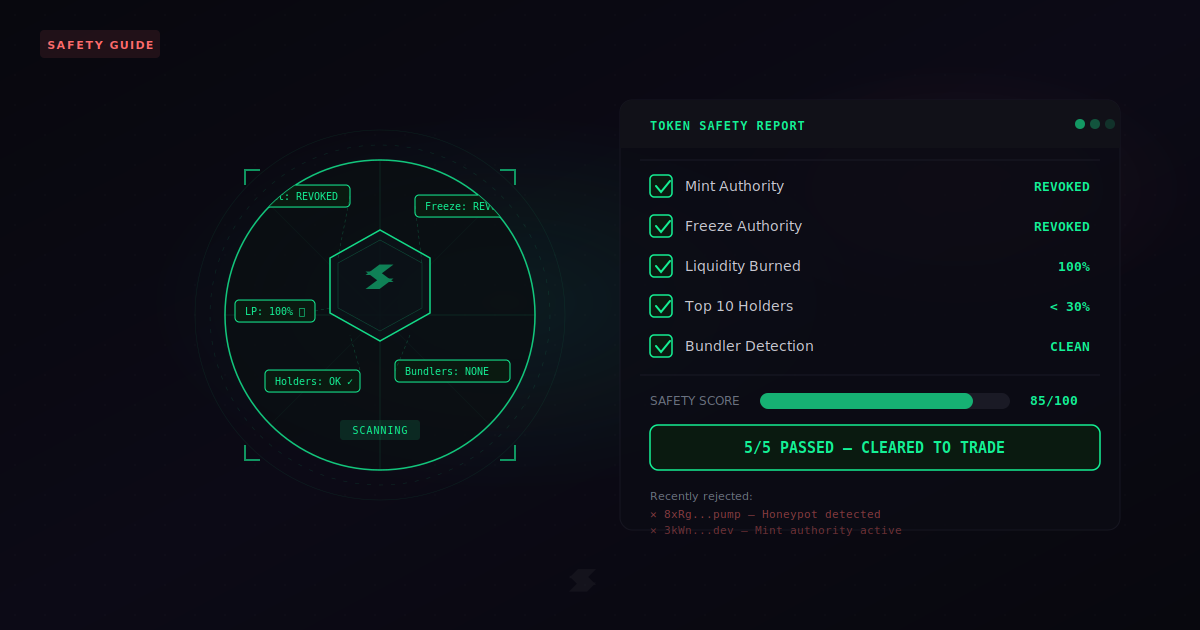
Run these five checks in order before every buy. Each one takes a few seconds. If a token fails any single check, skip it — there are thousands of new tokens every day, so there’s no reason to gamble on one that shows red flags.
✅ 5-Point Token Safety Check
Check if mint authority has been revoked. If it’s still active, the creator can mint unlimited new tokens at any time, inflating supply and crashing the price to zero. SAFE = “Mint Disabled” or “Revoked” · DANGER = “Active” or “Enabled”
If freeze authority is active, the token creator can freeze your token account, preventing you from selling or transferring. This is legitimate for stablecoins and regulated assets, but for memecoins it’s a massive red flag. SAFE = “Revoked” or “None” · DANGER = “Active”
Check two things: (a) Is there at least $5K–10K in the liquidity pool? Anything less means massive slippage and easy manipulation. (b) Are the LP tokens burned or locked? If LP tokens are unlocked, the creator can pull all liquidity at any moment (= classic rug pull). SAFE = LP burned 100% or locked with verifiable timelock · DANGER = LP unlocked or burn % below 90%
If the top 10 holders control more than 30% of total supply (excluding the burn address and LP), a small number of wallets can dump and crash the price. Also check if the developer wallet still holds a large percentage. SAFE = Top 10 < 30%, dev wallet < 5% · DANGER = single wallet > 10% (non-LP), top 10 > 40%
Check the first ~50 buyers of the token. If many wallets bought in the same block or within the first few seconds, it’s likely a bundled launch where the creator controls multiple wallets to simulate demand. GMGN flags the first 70 buyers and identifies snipers and insider wallets. SAFE = diverse early buyers, no bundler flags · DANGER = bundler detected, 10+ wallets buying in same block
The rule is simple: If a token fails any one of these five checks, don’t buy it. If it passes all five, it doesn’t mean it’s guaranteed profitable — it means you’ve filtered out the most common ways to lose everything.
Red Flags That Mean “Skip Immediately”
Beyond the checklist, these patterns are almost always scams. If you see any of them, move on — no further analysis needed.
🚩 Instant Skip — Don’t Even Think About It
- You can buy but can’t sell: This is a honeypot. If you see other wallets failing to sell (check the transaction history), or if your own test sell fails, the token’s contract is blocking sells. There is no fix — your money is trapped. See why trades fail for diagnosis steps
- Liquidity dropped suddenly: If the pool had $50K five minutes ago and now has $2K, the creator pulled liquidity. This is a completed rug pull. Don’t try to “buy the dip” — there is no dip, the value is gone
- Sell tax is extremely high: Some tokens allow buys at normal rates but charge 50–99% on sells. Check the buy/sell tax on GMGN or RugCheck. If sell tax is above 10%, it’s designed to trap you
- Permanent Delegate extension active: This Solana token extension can allow a delegated address to move or burn tokens from any holder’s account under certain conditions. Scammers have used it to burn tokens seconds after purchase. If you see “Permanent Delegate” flagged on scanners, treat it as high risk and skip
- Metadata is mutable + suspicious: If the token’s update authority hasn’t been revoked, the creator can change the token name, logo, and links at any time. Scammers change metadata after launch to make a phishing link look official. Pump.fun tokens revoke update authority by default, but tokens from other launchpads may not
- 15–20% of trades sold in under 5 seconds: This pattern indicates the wallet (or token creator) is farming copy traders — they buy, copiers follow, price spikes, they dump instantly. If you see rapid-fire buys and instant sells in the transaction history, the token is bait
Tools That Make This Easy
You don’t need to read contract code. These tools automate the five checks and display results visually in seconds. Use at least two — no single tool catches everything.
RugCheck.xyz — The Standard Solana Token Scanner
RugCheck is the most widely used token safety tool on Solana. Paste any token address and it instantly shows mint authority status, freeze authority, LP burn percentage, top holders, and a risk score. It also has a beta “Insider Networks” feature that detects suspicious relationships between top holder wallets.
Best for: Quick first-pass safety check. Takes 2 seconds to paste an address and see the result. Integrated into many bots and platforms.
Limitation: False positives on very new tokens with low holder counts. Doesn’t simulate actual buy/sell transactions. Can miss sophisticated scams that change behavior after launch.
GMGN — Built-In Security Checks While You Trade
GMGN includes contract security checks directly in the trading interface, so you see safety data before you buy without switching to a separate tool. The checks include: honeypot detection (via GoPlus), LP burned status, whether the contract is renounced, mintable status, top 10 holder concentration, blacklist detection, and insider/bundler flags for the first 70 buyers.
Best for: Traders who want safety checks integrated into their workflow, not as a separate step. Especially useful for copy trading — you can verify the tokens your tracked wallets are buying before you mirror the trade.
Limitation: Honeypot detection relies on third-party data (GoPlus) and may have slight delays. Always cross-reference with RugCheck on high-value trades.
Birdeye & Dexscreener — Chart + Holder Analysis
Birdeye and Dexscreener are primarily chart and analytics platforms, but they’re essential for safety checks that the automated scanners miss. Look at the actual transaction history: are there real, diverse buyers? Is volume organic or wash-traded? Does the chart show healthy price discovery or a single vertical spike followed by a cliff?
Best for: Verifying that a token which “passes” automated checks actually has organic trading activity. Numbers can be faked — chart patterns are harder to fake.
Axiom’s Vision Tool — Real-Time Token Filtering
Axiom’s Vision is a real-time token scanner with customizable safety filters built into the trading terminal. You can set minimum holder counts, bundle detection thresholds, maximum dev holding percentages (recommended: under 20%), and sniper percentage caps (recommended: under 10%). Tokens that don’t pass your filters are automatically excluded from your feed.
Best for: Proactive filtering — instead of checking each token manually, you pre-set your safety requirements and only see tokens that pass.
| Tool | Checks | Speed | Best Use |
|---|---|---|---|
| RugCheck | Mint, freeze, LP, holders, insider networks | ~2 sec | First-pass safety scan (paste address → result) |
| GMGN | Honeypot, LP burn, renounced, mintable, top 10, bundlers, first 70 buyers | Built-in | Integrated checks while trading or copy trading |
| Birdeye / Dexscreener | Chart patterns, holder distribution, volume, transaction history | ~5 sec | Verifying organic activity after automated checks pass |
| Axiom Vision | Bundle detection, dev holding %, sniper %, holder count | Real-time | Pre-filtering tokens before they reach your feed |
Safe Bot Settings for Risky Tokens
Even when a token passes all five checks, memecoins on Solana are inherently volatile. Your bot settings are the last line of defense between a manageable loss and a blowup. Here’s what to configure:
Slippage: Keep It Low, Don’t Force Trades
The most common mistake: raising slippage to 50%+ to “make sure the trade goes through.” This guarantees a terrible entry price. For memecoins, keep slippage at 5–15%. If a trade keeps failing even at 15%, the problem is usually priority fee, not slippage — or the token itself is problematic.
Detailed breakdown of when and how to adjust: Solana Slippage Settings Guide
Priority Fee: Pay for Speed, Not Certainty
Priority fee gets your transaction processed faster during network congestion. The recommended range is 0.0003–0.0006 SOL for normal conditions, scaling up to 0.001–0.003 SOL during extreme congestion. Remember: you pay the priority fee even if the trade fails, so setting it too high on frequent trades burns your balance fast.
Full priority fee strategy: Solana Priority Fees Guide
Always Set TP/SL — No Exceptions
Every trade needs an exit plan before you enter. Recommended starting point:
- Take profit: +100% (sell 50% of position), +300% (sell remaining)
- Stop loss: -30% (sell 100% of position)
- Dev sell protection (if available): If the developer sells a significant portion, auto-exit your position
Without TP/SL, you’re relying on yourself to manually exit under pressure — and most people hold too long or panic-sell too late. Your bot handles this better than you will.
If You Already Bought a Scam Token
If you suspect you’re holding a honeypot or scam token, follow this emergency protocol:
⚠ Emergency Protocol
- Try a small test sell first. Sell 10% of your position. If it goes through, sell the rest immediately. Don’t wait to see if the price recovers
- If the first sell fails, try once more with slightly higher slippage (increase by 5%). Set a fast priority fee (0.001+ SOL)
- If two sells fail, stop trying. The token is almost certainly a honeypot. Every failed sell attempt still costs you a priority fee. Further attempts just drain your SOL wallet
- Check the transaction history. If you see other wallets also failing to sell, it confirms the token is blocking sells at the contract level. There is no way to recover funds from a true honeypot
- Revoke token approvals. Even if you can’t sell, go to your wallet and revoke any approvals you granted to the scam token’s contract. This prevents it from interacting with your wallet further
For a step-by-step diagnosis of why a specific trade failed — including distinguishing between slippage failures, priority fee issues, and actual honeypots — see our trade failure diagnosis guide.
The 5 Most Common Solana Token Scams in 2026
Scam patterns evolve, but in 2026 these five account for the vast majority of losses on Solana:
1. The Classic Rug Pull
How it works: Creator launches a token, buys some with their own wallets to generate volume, waits for outside buyers, then removes all liquidity from the pool. Your tokens are now worthless because there’s nothing to sell them into.
How to catch it: Check #3 (LP burned/locked). If LP tokens are unlocked and the token is less than a few hours old, treat it as high risk regardless of other signals.
2. The Honeypot
How it works: The token contract allows buys but blocks sells — either completely, or by imposing a 90–100% sell tax. Everything looks normal until you try to exit. Some sophisticated honeypots only activate the sell block after a certain number of buys or after a time delay.
How to catch it: Check the buy/sell tax ratio on GMGN or RugCheck. Look at the transaction history — if you see many buys but almost no sells, it’s a honeypot. GMGN’s honeypot detection (via GoPlus) catches most common variants.
3. The Bundled Launch
How it works: The creator controls 10–50 wallets that all buy the token in the same block at launch, making it look like there’s massive demand. Real traders see the volume and FOMO in. The creator then dumps from all wallets simultaneously.
How to catch it: Check #5 (bundlers). GMGN flags bundled transactions and shows whether the first buyers are likely controlled by the same entity. If 10+ wallets buy in the same block at launch, skip it.
4. The Permanent Delegate Burn
How it works: The token uses Solana’s “Permanent Delegate” token extension, which can allow a delegated address to transfer or burn tokens from any holder’s account. In reported cases, scammers have burned victims’ tokens within seconds of purchase. Your wallet shows the buy happened, but the tokens disappear.
How to catch it: RugCheck and some bot interfaces flag tokens with Permanent Delegate active. If you see this flag, treat it as high risk and skip the token. Recovery after purchase is extremely unlikely.
5. The Copy Trader Trap
How it works: A wallet builds a legitimate-looking trading history with real profits over 1–2 weeks. It gets noticed on GMGN’s smart money rankings. People start copy trading it. Then the wallet starts buying scam tokens — the copy traders automatically follow, pump the price, and the wallet dumps into the crowd.
How to catch it: This is why the copy trading guide recommends watching wallets for at least 48 hours, testing with tiny amounts, and checking if 15–20% or more of their trades are sold within seconds. If a wallet’s behavior suddenly changes, pause the copy task immediately.
Bot-Specific Safety Features
Each major Solana trading bot handles token safety differently. Here’s what each offers and what you need to do manually:
| Safety Feature | GMGN | Trojan | Axiom |
|---|---|---|---|
| Honeypot detection | Built-in (GoPlus) | Basic warnings | Via Vision filters |
| Mint/freeze authority check | Yes (CA Security Checks) | Limited | Via Vision filters |
| LP burn/lock status | Yes | Limited | Yes |
| Bundler/insider detection | Yes (first 70 buyers) | No | Yes (bundle detection filter) |
| Top holder concentration | Yes (top 10 < 30%) | No | Yes (customizable threshold) |
| Dev sell auto-exit | Yes (configurable) | No | No (manual) |
| Anti-MEV protection | Yes (Jito) | Yes | Yes |
| External check recommended | RugCheck for high-value trades | RugCheck + GMGN for all trades | RugCheck for verification |
Bottom line: GMGN has the most comprehensive built-in safety checks. If you use Trojan, you need to run safety checks externally (RugCheck + GMGN web) before every trade. Axiom’s Vision tool automates pre-filtering but still benefits from RugCheck verification on specific tokens.
For full setup walkthroughs: GMGN guide · Trojan guide · Axiom guide
FAQ
Can bots protect me from scam tokens?
Partially. Bots like GMGN have built-in safety checks (honeypot detection, LP status, mint authority flags) that catch common scams. But no tool catches 100% of scams — sophisticated ones can pass automated checks and change behavior after launch. Bots are a first line of defense, not a guarantee. Always cross-check with RugCheck on high-value trades and never rely on a single tool.
How do I know if I can sell a token before I buy?
Check three things: (1) Look at the buy/sell transaction history on Dexscreener or Birdeye — if you see many buys but almost no sells, it’s a honeypot. (2) Check the buy/sell tax on GMGN or RugCheck — if sell tax is above 10%, it’s designed to trap you. (3) After buying, do a small test sell (10% of your position) before committing more. If the test sell fails, treat the entire position as lost.
What liquidity level is “safe” for a Solana memecoin?
There is no perfectly “safe” amount, but $5K–10K is a practical minimum for memecoins. Below that, even a small buy or sell causes massive price impact (slippage), and the token is easily manipulated. More important than the dollar amount: is the LP burned or locked? A pool with $50K in unlocked LP is more dangerous than one with $10K in burned LP, because the $50K can vanish in one transaction.
Why does my swap fail even on tokens that pass safety checks?
Passing safety checks means the token isn’t a scam — it doesn’t mean your trade will execute. Failed swaps are usually a settings issue: slippage set too low for the token’s volatility, or priority fee too low during network congestion. Try increasing slippage to 10–15% and priority fee to 0.0005+ SOL. For full troubleshooting steps, see the slippage guide and priority fees guide.
Can a token that passes all checks today become a scam tomorrow?
Yes. If the token contract still has active authorities (mint, freeze, or update), the creator can change behavior after launch. A token that isn’t a honeypot now can become one later if the code is upgradeable. This is why revoked authorities matter so much — they permanently lock the contract’s behavior. Always check that mint and freeze authorities are revoked, not just “looks safe right now.”
Is RugCheck always accurate?
No. RugCheck is the most widely used Solana token scanner, but it has limitations: it can produce false positives on very new tokens with few holders, it doesn’t simulate actual buy/sell transactions (it checks contract code and on-chain data), and sophisticated scams can evolve to bypass known detection patterns. Treat RugCheck as one input in your decision, not a definitive verdict. Cross-reference with GMGN’s built-in checks and verify trading activity on Dexscreener.
For a full comparison of all Solana trading bots — including safety features, sniping, copy trading, and setup guides — see our best Solana trading bots comparison.